The Yangtze River
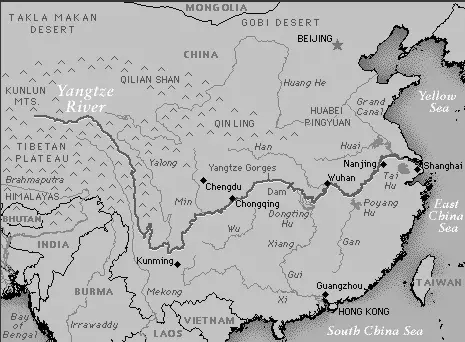
The Yangtze is the world's third-longest river at 3,917 miles. Its source is on the Qinghai-Tibet Plateau, in western China. Its mouth is the East China Sea, near Shanghai. The Yangtze flows through nine provinces of China and drains an area equal to 695,000 square miles of land.
The river is also a bringer of commerce. In its annual travels, the Yangtze brings huge amounts of silt on shore in the Jiangsu Province, where rice is grown. This large plain is home to a large part of the world's rice production. The Yangtze also passes through the Three Gorges (Qutang, Xiling, Wu), a beautiful region that has been known more recently for a series of dam projects that have created controversy and struggles between developers and environmentalists.
Graphics courtesy of ArtToday |
|





 The river has served as a means of transportation for 2,000 years. Settlements sprang up on the banks of and near the Yangtze River very early in the history of human civilization. Large ships can still sail 1,000 kilometers inland; steamers can go even farther, as far as 1,600 kilometers from the sea. The river is also used for sight-seeing tours and for private travel.

Social Studies for Kids
copyright 2002–2026
David White