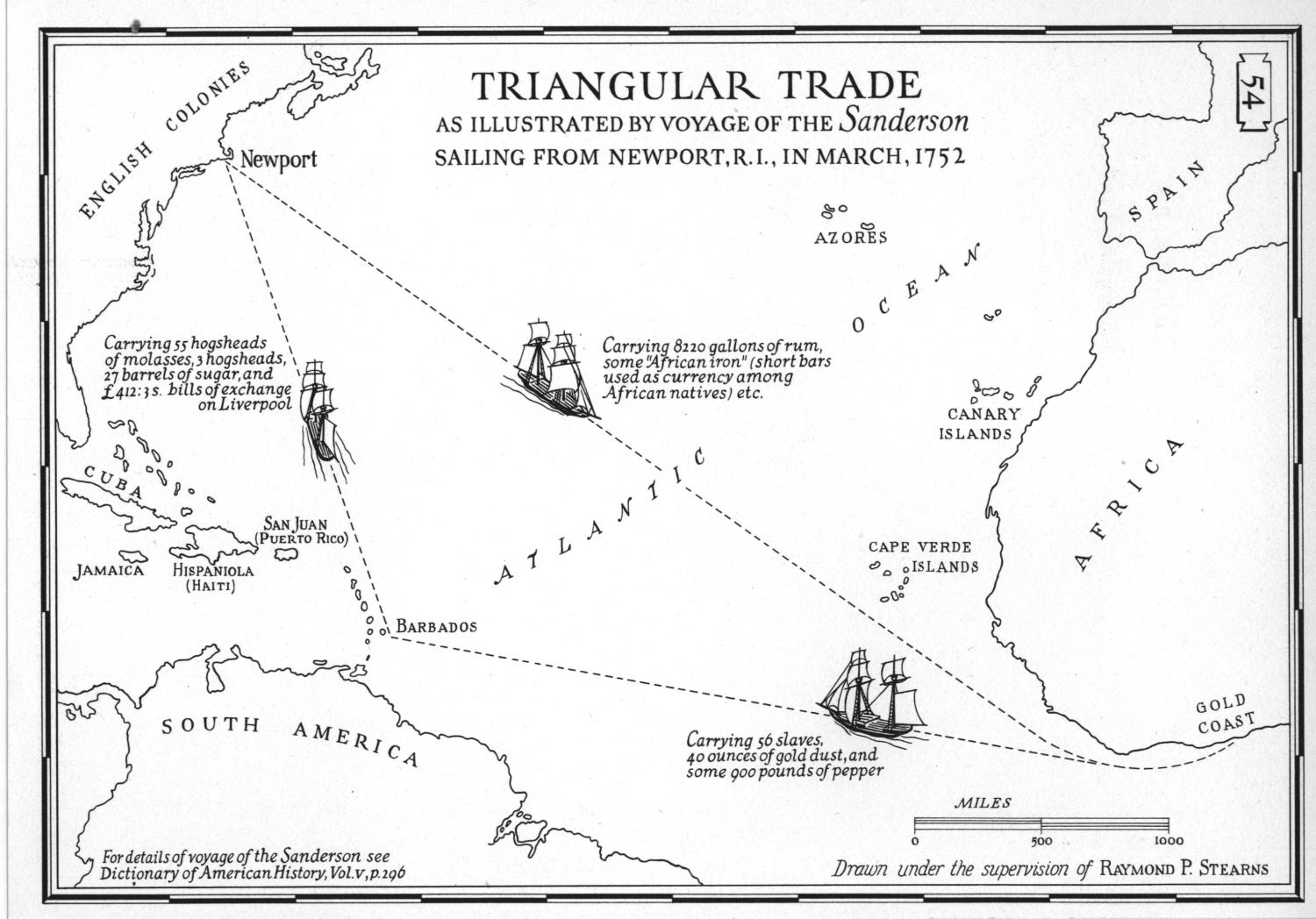
In early American settlement, goods came from two main sources: England and Africa. This came to be known as Triangular Trade.
A typical shipment of goods from Great Britain would consist of any or all of beads, cloth, hardware, rum, salt, or weapons. The shipment would go to Africa, where the goods would be traded for people who were enslaved. A ship leaving Africa for America would contain hundreds of enslaved people, tightly packed in horrific conditions for the journey to their new "home." Once in America, the ship would unload the slaves and take on any or all of molasses, rum, sugar, or tobacco and then head to Great Britain, completing the Triangle. (Not all ships made this giant triangular trip. Many ships did no more than sail back and forth from America to Africa and vice versa or from England to Africa and vice versa. The description of the Triangular Trade deals more with the goods as a whole.) Some of the ships coming to America sailed straight to ports along the Eastern Seaboard, although some stopped in the Caribbean or Brazil, where large slave plantations were. The number of Africans shipped as slaves to America has been conservatively estimated at 10 million. That number doesn't include the thousands who died along the way. Some estimates have concluded that 15 to 25 of every 100 Africans died on those voyages. The slave trade had a history of hundreds of years. It was made illegal in America in 1807, although it continued in small part for many years after that. |
|






Social Studies for Kids
copyright 2002–2026
David White