
|

|
|
|
|
|
|
Share This Page
|
|
|
|
|
|
|
Follow This Site

|
 |
|
|
|
|
|
The Puritan belief in the devil and witchcraft spawned a massive effort to eradicated supposed evil influence, both in Europe and in America. Witch hunts had been perpetrated in Europe for hundreds of years before Salem, Massachusetts, had its caustic episode. Belief in the supernatural—both good and evil—was so strong, especially in Puritan New England, that things unexplained were explained as being either God's grace or the work of the devil, with no gray area.
Puritan preachers didn't exactly help matters. Cotton Mather, especially, stoked the first of supernatural belief by publishing a book titled Memorable Providences Relating to Witchcrafts and Possessions, in which he described in some detail the practice of witchcraft and the symptoms said to be exhibited by those who were victims of such dastardly deeds. Mather's book was published in the latter half of the 17th Century and was very much the talk of the town in Salem and elsewhere.
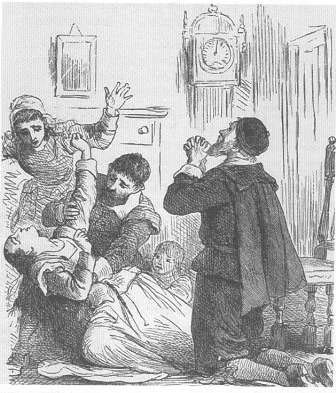 The madness began in January 1692, when Elizabeth Parris, daughter of the Rev. Samuel Parris, and her cousin Abigail Williams began exhibiting bizarre behavior, such as convulsions and trances. Soon, other girls followed suit. Their actions were soon noticed by their parents, who took them to village doctors, who could find nothing physically wrong with them and concluded that they must be possessed by the devil. The madness began in January 1692, when Elizabeth Parris, daughter of the Rev. Samuel Parris, and her cousin Abigail Williams began exhibiting bizarre behavior, such as convulsions and trances. Soon, other girls followed suit. Their actions were soon noticed by their parents, who took them to village doctors, who could find nothing physically wrong with them and concluded that they must be possessed by the devil.
Frightened, the girls say that they hadn't made a deal with the devil but that other people had and were making them targets. Among the "witches" the girls named was Tituba, a slave of the Parris family. But the girls didn't stop there: They also named Sarah Good and Sarah Osborne, women of the village, as witches.
History doesn't record the details of the questioning that Tituba underwent at the hands of the village authorities. We know only that on March 1, she confessed to practicing witchcraft. Good and Osborne, meanwhile, maintained their innocence.
In the next few weeks, more and more people came forward and named others as witches. Magistrates Jonathan Corwin and John Hathorne examined all of these women in turn, including Martha cory, Rebecca Nurse, Elizabeth Proctor, Saray Cloyce (Nurse's sister), John Proctor (Elizabeth Proctor's husband), Abigail Hobbs, Bridget Bishop, Giles cory, and Mary Warren.

In late April, the list of those accused and examined by the magistrates grew and included Nehemiah Abbot, William Hobbs, Deliverance Hobbs, Edward Bishop, Sarah Bishop, Mary Easty, Mary Black, Sarah Wildes, Mary English, Sarah Morey, Lydia Dustin, Susannah Martin, and Dorcas Hoar. Abigail Hobbs confessed to practicing witchcraft. Nehemiah Abbot was cleared of all charges. The rest of those examined were kept in prison.
Events started to accelerate in May. George Burroughs and Sarah Churchill, one of the afflicted girls, were examined, as were George Jacobs, Sr. and his granddaughter Margaret, who not only confessed to practicing witchcraft but named her grandfather and Burroughs as warlocks. On May 10, the Salem witch hunt claimed its first victim, as Sarah Osborne died in prison.
A new colonial governor, William Phips, arrived on the scene in May and set up of a Court of Oyer and Terminer to try the witchcraft cases. Since the accusations involved supernatural activity, the judges based their decisions on such things as "witchmarks" and spectral evidence. Direct confessions, no matter how forced, were given special gravity. The Court produced its first verdict, guilty, on June 2, pronouncing Bridget Bishop guilty of witchcraft and sentencing her to death. She was hanged eight days later.
At the end of June, Sarah Good, Elizabeth Howe, Rebecca Nurse, Susannah Martin, and Sarah Wildes were given the same sentence as Bridget Bishop. They were hanged on July 19.
Emboldened, the Court of Oyer and Terminer heard more cases and handed down more sentences. In August, George Burroughs (a former minister), Martha Carrier, George Jacobs, Sr., Elizabeth Proctor, John Proctor, and John Willard were sentenced to death. They were all hanged on August 19.
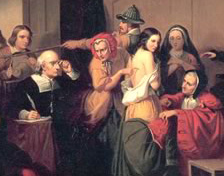 Despite growing doubts about the presence of witchcraft, the judges continued to examine accused and hand down death sentences. In September alone, 16 people were found guilty and sentenced to death. Eight of them—Martha Cory, Margaret Scott, Mary Easty, Alice Parker, Mary Parker, Ann Pudeator, Wilmott Redd, and Samuel Wardwell—were hanged on September 22. A few days before, Giles cory was pressed to death with heavy stones for refusing a trial and Dorcas Hoar had her execution delayed by changing her innocent plea to guilty. Despite growing doubts about the presence of witchcraft, the judges continued to examine accused and hand down death sentences. In September alone, 16 people were found guilty and sentenced to death. Eight of them—Martha Cory, Margaret Scott, Mary Easty, Alice Parker, Mary Parker, Ann Pudeator, Wilmott Redd, and Samuel Wardwell—were hanged on September 22. A few days before, Giles cory was pressed to death with heavy stones for refusing a trial and Dorcas Hoar had her execution delayed by changing her innocent plea to guilty.
By October, 20 people had been executed. Fear had begun to dissipate somewhat, and opposition to the court's actions and the village's hysteria became more vocal. The Court of Oyer and Terminer was dissolved on October 29. All remaining accused were tried by the Massachusetts Colony Superior Court and acquitted.
No further accusations or condemnations came forth from the people of Salem. The legacy of 20 executions remained, however.
|
|


