
 |
 |
 |
 |
 |
 |
 |
 |
Part 2: American Victory
A large part of wartime communication was messages sent in code. By 1942, American codebreakers had broken the Japanese code. American military commanders knew that almost the entire Japanese fleet was headed to Midway Island in early 1942.
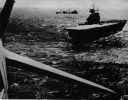 Taking
a huge risk, the U.S. Navy decided to send most of its fleet
there, too. In a bold surprise attack, the U.S. defended
Midway Island and succeeded in sinking four of Japan's six
aircraft carriers. It was a stunning victory, from which
Japan would never quite recover.
Taking
a huge risk, the U.S. Navy decided to send most of its fleet
there, too. In a bold surprise attack, the U.S. defended
Midway Island and succeeded in sinking four of Japan's six
aircraft carriers. It was a stunning victory, from which
Japan would never quite recover.
A month earlier, the U.S. had won a victory in the Coral Sea, near Australia. The next year, the U.S. liberated Guadalcanal, in the Solomon Islands. This began a series of "island hopping" battles, in which American forces would seize Japanese-held islands with the ultimate goal of being able to use them as bases for an attack on the Japanese homeland.
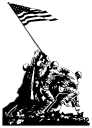 More
islands were liberated: Guam in 1944, Iwo Jima and Okinawa
in 1945. Even the Philippines was taken from Japanese
control.
More
islands were liberated: Guam in 1944, Iwo Jima and Okinawa
in 1945. Even the Philippines was taken from Japanese
control.
But Japan wouldn't give up. The fighting for the islands had been fierce, and Japanese pilots had taken to flying "kamikaze" raids, in which they intentionally flew their planes into American ships, hoping to sink them.
President Franklin Roosevelt died in April 1945. His vice-president, Harry Truman, became president. He was troubled by his options for defeating Japan. It was thought that an invasion of Japan would cost 1 million American lives. Based on that and many other factors, Truman decided to allow the Army to drop two atomic bombs on Japan.
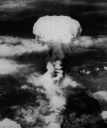 Hundreds
of thousands of people were killed and injured in the
bombings of Hiroshima and Nagasaki on August 6 and August 9.
Japan surrendered five days later.
Part
2: American Victory
Hundreds
of thousands of people were killed and injured in the
bombings of Hiroshima and Nagasaki on August 6 and August 9.
Japan surrendered five days later.
Part
2: American Victory
A large part of wartime communication was messages sent in code. By 1942, American codebreakers had broken the Japanese code. American military commanders knew that almost the entire Japanese fleet was headed to Midway Island in early 1942.
Taking
a huge risk, the U.S. Navy decided to send most of its fleet
there, too. In a bold surprise attack, the U.S. defended
Midway Island and succeeded in sinking four of Japan's six
aircraft carriers. It was a stunning victory, from which
Japan would never quite recover.
A month earlier, the U.S. had won a victory in the Coral Sea, near Australia. The next year, the U.S. liberated Guadalcanal, in the Solomon Islands. This began a series of "island hopping" battles, in which American forces would seize Japanese-held islands with the ultimate goal of being able to use them as bases for an attack on the Japanese homeland.
More
islands were liberated: Guam in 1944, Iwo Jima and Okinawa
in 1945. Even the Philippines was taken from Japanese
control.
But Japan wouldn't give up. The fighting for the islands had been fierce, and Japanese pilots had taken to flying "kamikaze" raids, in which they intentionally flew their planes into American ships, hoping to sink them.
President Franklin Roosevelt died in April 1945. His vice-president, Harry Truman, became president. He was troubled by his options for defeating Japan. It was thought that an invasion of Japan would cost 1 million American lives. Based on that and many other factors, Truman decided to allow the Army to drop two atomic bombs on Japan.
Hundreds
of thousands of people were killed and injured in the
bombings of Hiroshima and Nagasaki on August 6 and August 9.
Japan surrendered five days later.
The war was over.
First page > Japanese Successes > Page 1, 2
|
Search This Site

Custom Search
|
Social Studies for Kids
copyright 2002–2026
David White