Book Review: Katie's Wish
This is a wonderful examination of the Irish potato famine and the effect it had on people in Ireland and America. The author, Barbara Shook Hazen, has taken this period in history and shown it to us through the eyes of young Katie, who learns a powerful lesson and witnesses history in the process. Tired of potatoes, which is all her family seems to eat, Katie wishes that the potatoes would just go away. Soon after, the potato blight hits. Potatoes turn black. Many people get sick, including Katie's grandmother. Katie assumes that all of that is her fault, for wishing the potatoes away. Meanwhile, her father has gone to America and is saving enough money to send for her. (Her mother has recently died.) Katie is torn between her love for her father and her need to stay with the rest of her family. The illustrations, by Caldecott Medal winner Emily Arnold McCully, are marvelous. In almost every case, the clothes that Katie wears (and certainly her red hair) make her stand out from the crowd. When Katie's favorite pet pig is sold at market for money to buy food, you can see the anguish on Katie's face. The illustrations do what they are supposed to do: help the story along. 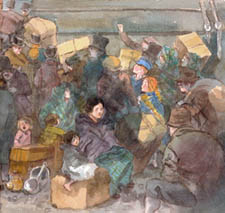 The result is an excellent example of how kids, especially young ones, equate things that aren't really related. Katie's wishing the potatoes away didn't really cause the potato blight and subsequent famine, but all she knows is that she did the wishing and they "went away." The world is not so often so black-and-white, and the adults in Katie's life tell her so. This is also an excellent example of how history is seldom so black-and-white. It is often thought that one thing caused another or that only one outcome was possible. History is just the present of earlier days; and just as with our own present, which has a myriad of possibilities for even the tiniest choices or cause and effect, so, too, did the past. Things are always more complicated than they appear at first glance, and the lesson that Katie learns in this book is to look deeper, beyond the surface, to discover that life is complicated and wonderful and open-ended.
|
|







Social Studies for Kids
copyright 2002–2026
David White