American Centennials
The official date of independence for the United States is July 4, 1776. That is the day that Congress announced, through the Declaration of Independence, that the U.S. was no longer a colony of Great Britain but instead was a new nation.
As time has marched on, people living in the U.S. have stopped at various times to celebrate this series of events. Ever year, Americans celebrate July 4 as a national holiday.
1826: Semicentennial
Fifty years later, in 1826, not much went on in terms of celebrating a significant anniversary of July 4. The people were busy continuing to build the new nation. Coincidentally, both John Adams and Thomas Jefferson, two of the most influential Founding Fathers, died on that day.
1876: Centennial
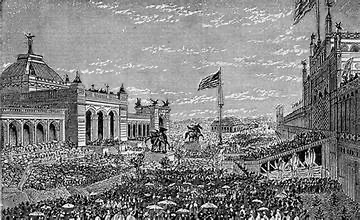 It wasn't until the centennial, in 1876, that celebrations commenced in earnest. The Centennial Exposition in Philadelphia marked the 100-year anniversary of the signing of the Declaration. The exposition, which opened on May 10 and lasted six months, was the first world's fair to take place in the United States. In line with the then/burgeoning Industrial Revolution, exhibits highlighting machines and manufacturing featured prominently in the Main Exhibition Building. (Among the more well-known demonstrations was by inventor Alexander Graham Bell, whose first telephone call had taken place earlier that year.) Other halls housing exhibits were the Agricultural Hall, the Horticultural Hall, the Memorial Hall, and the Women's Pavilion. The latter was the first world's fair exposition to showcase the work of women and featured a modified version of the Declaration of the Rights of Women, drafted at the Seneca Falls Convention in 1848. Visitors could view the hand and torch of what would becom the Statue of Liberty. Root beer became famous at the Exposition, as did the Remington typewriter. Also on display, in the food department, was Heinz ketchup.
1926: Sesquicentennial
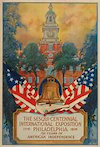 For the 150th anniversary, the sesquicentennial, Philadelphia was again the site of a exposition. Among the highlights of that gathering was an 80-foot replica of the Liberty Bell. A total of 26,000 light bulbs covered this gateway arch. Inside, organizers had created a replica of Philadelphia's High Street during the colonial period, complete with guides dressed in period clothing. Also featuring prominently was the Curtis Organ, with more than 10,000 pipes. Overall, however, the celebrations proved very costly and drove the city of Philadelphia into bankruptcy. Contributing to this was an overall poor attendance, with a total of 5 million attendees (whereas organizers had estimated that 30 million would show up).
1976: Bicentennial
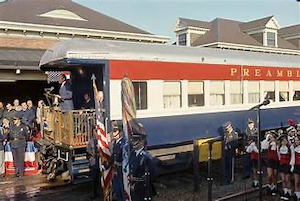 By far the largest and most widespread celebrations were to mark the bicentennial, in 1976. To publicize the events, the American Freedom Train began in Wilmington, Delaware, on April 1, 1975, and traveled to all 48 contiguous states during the next 21 months. Making a similarly themed journey was the Bicentennial Wagon Train Pilgrimage, which traced the routes of such overland ways west as the Bozeman Trail, California Trail, Mormon Trail, Old Post Road, Oregon Trail, Overland Trail, Santa Fe Trail, and the Wilderness Road. The pilgrimage began in Blaine, Wash., on June 8, 1975, and ended in Valley Forge, Penn., on July 4, 1976.
Getting into the 200-year spirit was President Gerald Ford, who lit a third lantern at Boston's Old North Church (channeling Paul Revere, who famously did so to warn "The British Are Coming! The British Are Coming!" The following day, Ford was in Concord, Massachusetts, to commemorate the first battles of the war, at Lexington and Concord. Ford later presided over the July 4 celebrations in Washington, D.C.
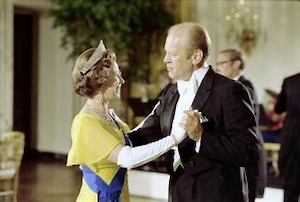
In the nation's capital, visitors watched a parade, the Grand Marshal of which noted country singer Johnny Cash. Attending as official visitors, as part of a state visit, were Queen Elizabeth II and Prince Philip of the United Kingdom. The queen had brought a special gift, the Bicentennial Bell, a replica of the Liberty Bell. As well, the U.K. loaned the U.S. one of the four existing copies of Magna Carta, which was on display in the U.S. Capitol. Also coming over for a state were President and Mrs. Giscard d’Estaing of France.
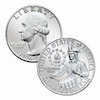
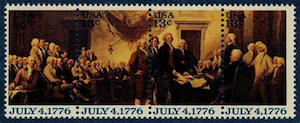
The Smithsonian Institution featured a replica of the 1876 Centennial Exposition. The U.S. Mint issued a series of bicentennial quarters. A great many U.S. postage stamps commemorated the bicentennial.
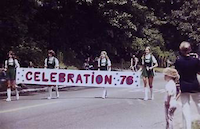
At the state and local level, celebrations dotted the country. Popular were parades, recitations of the Declaration, and events in which people donned period dress. A group of tall ships arrived in New York harbor to commemorate the bicentennial. Patriotic spirit swept the country, with banners and signs celebrating 200 years of independence dotting the landscape in hundreds of cities and towns.
|
|