The Strait of Hormuz: Geography and Global Importance
The Strait of Hormuz is a body of water between Iran and Oman and is vastly important economically and politically because it is the only waterway connecting the Persian Gulf to the world's oceans. 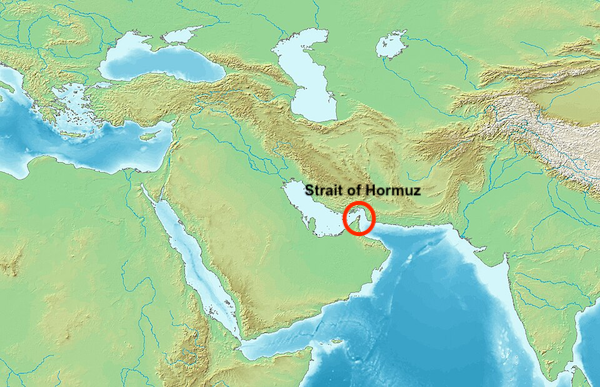
The strait measures about 104 miles in length overall, with its width varying from 35 miles to about 60 miles. Both Iran and Oman have territorial waters that extend into the strait. As well, Iran controls the eight major islands located within the strait. A very large number of ships move through the strait each day, transporting exports from Iran, Iraq, Kuwait, Qatar, Saudi Arabia, and the United Arab Emirates (UAE) to ports worldwide. Facilitating this movement is the Traffic Separation Scheme, whereby inbound ships use one two-mile-wide lane of the waterway and outbound ships use another. In between both of those lanes is a two-mile-wide middle lane. All of this is important in a global economic sense because one-fifth of the world's liquefied natural gas and one-quarter of the ship-carried oil travels through the strait. If the tankers carrying that oil and gas cannot pass through the strait, then they must find a longer way around (if possible), causing delays with delivery and potentially raising prices of the oil and gas being delivered. (As well, a large number of ships transport fertilizers from Middle Eastern ports to the wider world.) 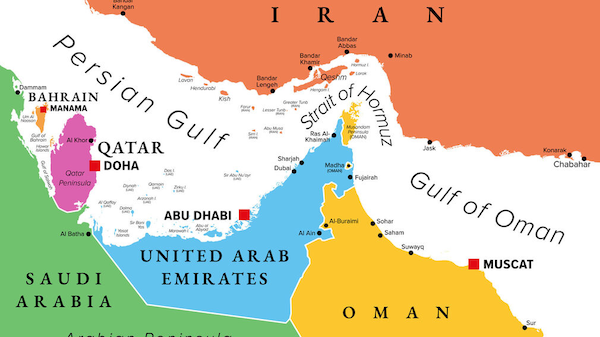
Tensions between countries in the area have long led to disputes over passage through the strait:
Theories for the naming of the Strait of Hormuz differ, tracing word origins to various religions popular in the Middle East in ancient times. In the Middle Ages arose the Kingdom of Hormuz (or Hormoz), which featured land around (and, in the case of the Island of Hormuz, in) the strait. Portugal conquered the kingdom in the 16th Century. Other European powers began using the strait not long afterward. |
|






Social Studies for Kids
copyright 2002–2026
David White