|
Men, Women, & Children Built Terracotta Warriors: Study
October 19, 2026
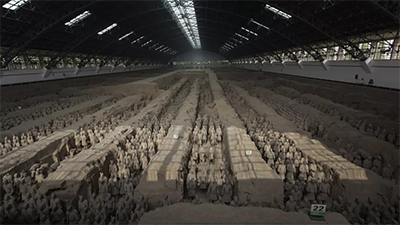
Researchers now think that men, women, and even children helped build the Terracotta Army, the fierce-looking warriors that have stood ready to defend a long-ago Chinese emperor's tomb for more than two centuries. Made up of more than 8,000 life-size clay sculptures of armed warriors, the army guards the tomb of China's first emperor, Qin Shi-huang-di, who died in the 3rd Century B.C. The statues are individually life-like, with different facial expressions and hairstyles and even different-colored uniforms. Heights of the warriors range from 5-foot-8 to 6-foot-6, with the height increasing with military rank. Many of the warriors are armed with spears and swords and stand in battle formation, ready to do battle with anyone who disturbs the emperor's tomb. Some of the warriors were armed with crossbows that were designed to fire if disturbed. Some warriors are in terracotta chariots. Terracotta horses feature in the army as well, either pulling chariots or wearing saddles in anticipation of bearing riders. The bottom of each figure is clay, and the top is hollow, making it easier for the relatively tall statues to remain upright. It is that clay that has yielded a strong hint that it wasn't just men who built the figures. Xiaoxi Li, an archaeologist at Emperor Qinshihuang's Mausoleum Site Museum, has released results of a study of handprint analysis in the clay. In making the warriors, the builders left their fingerprints all over the surface. Researchers found fingerprints on arms, heads, hands, feet, and armor of the figures. The remains of those efforts showed different widths between fingerprint ridges, strongly suggesting that women and even children lend their hands to the efforts (since the width between such ridges grows as a person ages). The study examined 91 fingerprints left on 36 warriors from one excavation pit. Of those, only 79 were clear enough to guarantee distinctive results. And the results showed that 55 percent of the fingerprints likely belonged to women and children. (The breakdown is 32.7 percent adult women and 22.3 percent boys and girls under 15.) The study, published in the Journal of Cultural Heritage, was unusual in that it focused on who built the warriors, not how or why the statues were built. |
Social Studies for Kids |