|
CURRENT EVENTS
Men, Women, & Children Built Terracotta Warriors: Study
October 19, 2026
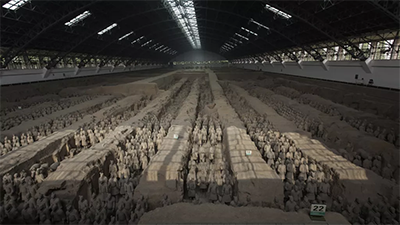 Researchers now think that men, women, and even children helped build the Terracotta Army, the fierce-looking warriors that have stood ready to defend a long-ago Chinese emperor's tomb for more than two centuries. Made up of more than 8,000 life-size clay sculptures of armed warriors, the army guards the tomb of China's first emperor, Qin Shi-huang-di, who died in the 3rd Century B.C. Terracotta horses feature in the army as well, either pulling chariots or wearing saddles in anticipation of bearing riders. The bottom of each figure is clay, and the top is hollow, making it easier for the relatively tall statues to remain upright. It is that clay that has yielded a strong hint that it wasn't just men who built the figures. In making the warriors, the builders left their fingerprints all over the surface. Researchers found fingerprints on arms, heads, hands, feet, and armor of the figures. The remains of those efforts showed different widths between fingerprint ridges, strongly suggesting that women and even children lend their hands to the efforts (since the width between such ridges grows as a person ages).
The Story of the Trojan War
The story of the Trojan War is just that–a story. Many of the events in that story are accepted as fact. Some of the people named in the story are known to have lived. Some of the things and places described in that story have been found or verified. Most of all, though, it is the stuff of legend.
The Strait of Hormuz: Geography and Global Importance
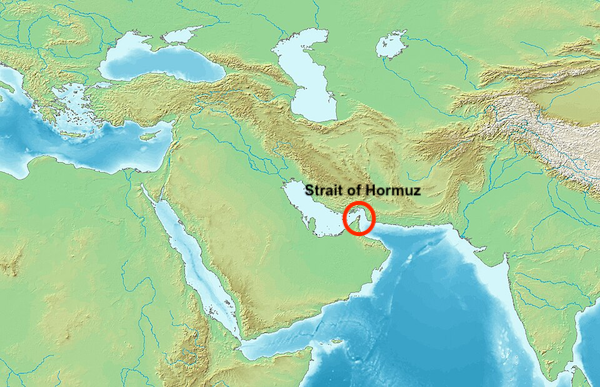 The Strait of Hormuz is a body of water between Iran and Oman and is vastly important economically and politically because it is the only waterway connecting the Persian Gulf to the world's oceans. A very large number of ships move through the strait each day, transporting exports from Iran, Iraq, Kuwait, Qatar, Saudi Arabia, and the United Arab Emirates (UAE) to ports worldwide. All of this is important in a global economic sense because one-fifth of the world's liquefied natural gas and one-quarter of the ship-carried oil travels through the strait. If the tankers carrying that oil and gas cannot pass through the strait, then they must find a longer way around (if possible), causing delays with delivery and potentially raising prices of the oil and gas being delivered. (As well, a large number of ships transport fertilizers from Middle Eastern ports to the wider world.)
|
COLONIAL AMERICA
Patrick Henry: Voice of Freedom
Patrick Henry was one of the leading lights of the American Revolution, a voice that would not be silenced until Americans were free and could govern themselves.
Samuel Adams: Ringleader of the American Revolution
 Described as a firebrand, a revolutionary, and a patriot, the young Adams was perhaps the most vocal of his generation to demand independence from Great Britain. He believed in the higher cause of independence, and he didn't often let laws that he thought unjust stand in his way. Described as a firebrand, a revolutionary, and a patriot, the young Adams was perhaps the most vocal of his generation to demand independence from Great Britain. He believed in the higher cause of independence, and he didn't often let laws that he thought unjust stand in his way.
Benjamin Franklin: America's Renaissance Man
Benjamin Franklin was one of the most famous people of his generation, his country, and his country’s history. He was as close as Colonial America came to having a Renaissance man.
John Hancock: The Money Behind the Revolution
 John Hancock is perhaps best known for his very large signature on the Declaration of Independence. However, he was much more important to the American Revolution and the Revolutionary War as a businessman who had large sums of money at his disposal and used that money to support the American cause. John Hancock is perhaps best known for his very large signature on the Declaration of Independence. However, he was much more important to the American Revolution and the Revolutionary War as a businessman who had large sums of money at his disposal and used that money to support the American cause.
The Boston Tea Party
What caused Americans to get so upset about tea? Find out in this easy-to-read article.
|
IN DAYS GONE BY
Statue of Liberty Dedicated
 The Statue of Liberty, symbol of freedom to the world, was dedicated in New York harbor on Oct. 28, 1886. The Statue of Liberty, symbol of freedom to the world, was dedicated in New York harbor on Oct. 28, 1886.
The Statue, many years in the making, was a gift from France and the brainchild of noted architect Auguste Bartholdi. The statue was built first in France, then dismantled and shipped to the U.S., where it was reassembled in time for the unveiling, to celebrate 110 years since the signing of the Declaration of Independence.
Find out more about this impressive landmark here.
Read a review of a great book on the Statue here.
The Gunfight at O.K. Corral
 The Gunfight at O.K. Corral lasted all of 30 seconds. It was, however, a landmark event in the American West. The setting was Tombstone, a frontier town in the Arizona Territory, in 1881. (Arizona did not become a state until 1912.) The date was October 26. The participants were two sets of tight-knit characters, one acknowledgedly on the wrong side of the law and the other straddling the line between upholding the law and breaking it.
Panic in the Streets: War of the Worlds on the Radio
Can a radio program cause a mass panic? It certainly did in 1938, as a hoax put on by a group of theater performers drove thousands of people into the streets in terror.
Martin Luther and the 95 Theses
 On October 31, 1517, a professor posted a request for an argument on a church door in a small German town. The result was a major religious transformation. The professor was Martin Luther. The request, a document that has come to be known as the 95 Theses, was Luther’s plea for a thorough discussion of the efficacy of Catholic Church doctrine and practice. The result was the Reformation. On October 31, 1517, a professor posted a request for an argument on a church door in a small German town. The result was a major religious transformation. The professor was Martin Luther. The request, a document that has come to be known as the 95 Theses, was Luther’s plea for a thorough discussion of the efficacy of Catholic Church doctrine and practice. The result was the Reformation.
|
ECONOMICS
(For a description of these fun, illustrated,
easy-to-read articles, click here.)
Making
a Budget
One
thing that every good
money manager does is make a budget. Find out why and
how.
Why
All the Graphics in
Economics?
 Economics needs so many graphs because it tracks trends and
other numerical information that other subjects in the
social studies don't, at least not nearly as often. Take the
mystery and difficulty out of charts, tables, and graphs!
Economics needs so many graphs because it tracks trends and
other numerical information that other subjects in the
social studies don't, at least not nearly as often. Take the
mystery and difficulty out of charts, tables, and graphs!
The
Importance of Trade
Trade is vital to the success of a civilization. Why? The
civilization that can produce just enough of everything it
and its people need to survive is rare indeed. Can you think
of an example, today or in the long history of people? Keep
thinking ...
|
GEOGRAPHY
Basic
Geography: The Equator and the Prime
Meridian
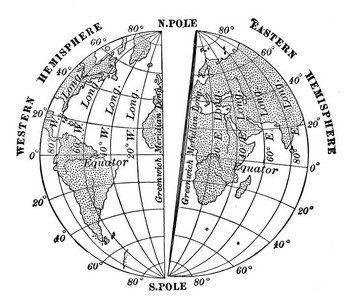 The
earth is a globe, of
course, and can be divided into lots of lines called
latitude and longitude. Latitude
lines run north and south; longitude lines run east and
west. The lines measure distances in degrees. But where do you start? Where
is 0 degrees? This
illustrated article answers those questions and more in a
fun, easy-to-read way.
The
earth is a globe, of
course, and can be divided into lots of lines called
latitude and longitude. Latitude
lines run north and south; longitude lines run east and
west. The lines measure distances in degrees. But where do you start? Where
is 0 degrees? This
illustrated article answers those questions and more in a
fun, easy-to-read way.
Latitude
and Longitude
Latitude and Longitude help us identify the location of
places on a globe. These links give you a better
understanding of these important concepts.
Unforgiving Places
Deserts, mountains, wastelands—these are some of the planet's Unforgiving Places. Learn more about these lonely yet intriguing destinations.
|
ANCIENT ROME
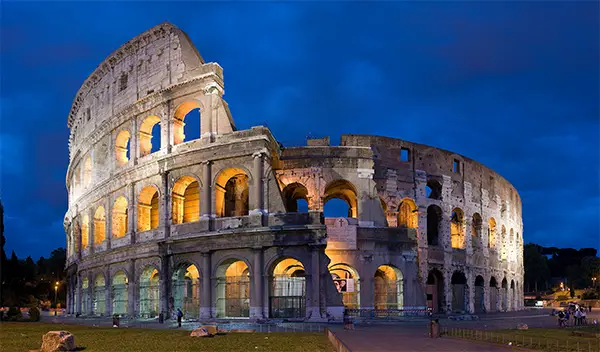
 The Roman civilization was full of famous people, places, and things. One of the giants of the ancient civilizations was Rome: the city, the republic, the empire, and much more.
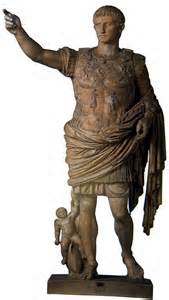
Among the more well-known ancient Romans were Julius Caesar, Augustus (right), Pompey, Nero, Caligula.
An elaborate slave class powered the might of Rome, and perhaps no slave was more famous than Spartacus, who led a large-scale revolt in the year 73.
Rome had many enemies. Among the most well-known were Hannibal, Atilla the Hun, Alaric the Visigoth, the Etruscans, the Samnites, and the Parthians. It was the Roman legion that won the wars and kept the peace for a great many years. Rome also suffered through years of internal strife.
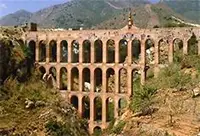
The Romans were great builders, of roads, aqueducts, baths, and temples. They built a system of laws that formed the basis for many a legal system to follow.
|
ANCIENT AND MEDIEVAL MESOAMERICA AND SOUTH AMERICA
|
| The Ancient Olmecs
 The Olmecs were one of the first advanced civilizations in Mesoamerica and, as such, influenced later, more well-known civilizations in that area.
|
The Ancient Maya
 From humble beginnings in the Yucatan, the Maya rose to dominance across what is now Central America and southern Mexico, spreading their knowledge of science, architecture, and survival far and wide.
|
The Aztecs
 The Aztecs were an economic and cultural powerhouse, ruling much of what is now Mexico and the surrounding area for a few centuries in the late Middle Ages. They came to power by defeating internal rivals, and they lost power by underestimating an overseas foe.
|
The Inca
 The Inca Empire stretched thousands of miles along the western coast of South America. At its height, this empire, with its capital at Cuzco, was the largest in the world.
|
|
Why Is It Called a River Delta?
As with many things, the answer lies in Ancient Greece.
Why Is It That American Elections Are on Tuesday?
Elections in American happen on a Tuesday. That's the law. But why?
Why Is It Called Big Ben?
Big Ben is actually the giant bell inside the famous Clock Tower in London. It is not the only bell in the tower, and it is certainly not the tower itself.
Significant Sevens are the highest, the lowest, the deepest, the farthest, the oldest, the youngest, and a host of other lists in economics, geography, history, and much more.
The 7 Most Visited National Parks in the U.S.
The 7 Longest Train Journeys in the World
|
Cultural Icons are the instantly recognizable monuments, landforms, buildings, and many other kinds of landmarks that define a people, place, or culture.
Angkor Wat
The Angkor Wat complex, the world's largest religious monument, has as its main features a 213-foot-tall central tower and four surrounding smaller towers, enclosed by a number of walls and a surrounding moat.
The
Brooklyn Bridge
The Brooklyn Bridge, still one of the world's longest suspension bridges, opened to the public on May 24, 1883.
The Eiffel Tower
The Eiffel Tower was once criticized for its design. It is now, and has been for some time, one of the most recognized and visited structures in the world.
Versailles
The opulent palace and grounds were the seat of government and playground of French monarchs for many years. Now, annual visitors top 3 million.
|
|
Search This Site
Get weekly newsletter
GET THESE GREAT BOOKS

It's a detailed rundown of ALL of the Cabinet members of EVERY president. Trace the history of America in a novel new way.
 
More on the U.S. Government.
|
DID YOU KNOW?
It took a century ... 
Ludwig van Beethoven's iconic piano composition Fur Elise wasn't published for more than a century after he wrote it.
Find out why.
Actress and inventor
 Actress Hedy Lamarr was one of the most famous actresses of her generation, starring opposite such famous leading men as Clark Gable, John Garfield, Spencer Tracy, and Robert Young. She was also a scientist and inventor. One of her inventions forms the basis of much of today's wireless technology.
Find out more.
Who drives on which
side of the road

Several dozen of the world's countries and territories stipulate that drivers must adhere to the left side of the road; the rest of the world, about two-thirds of the population, drives on the right. Ever wonder why some countries have drivers go on the left?
Find out here.
Canals once powered commerce

Before the advent of the railroad, many American goods and people traveled by river, along a network of canals. An entire industry grew up around the shipping of goods by canal. Ship captains made their living shipping goods back and forth between cities and ports. In between journeys, captains and boat workers lived in communities along canals.
Find out more.
The 1st licensed female pilot

Baroness la Deroche was the first woman to earn a pilot's license. She did so in 1910. The Frenchwoman flew planes in airshows in several countries, including Egypt, France, Hungary, and Russia.
Find out more.
Demand for tulips once
ruined many fortunes

The Dutch Tulip Bubble was an economic episode that bankrupted many individuals and cost many others their credibility but left the government and its treasury and reputation largely unscathed. Many people also refer to this episode as Tulip Mania.
Find out more.
|
|
|
|
|